
Food insecurity is a development challenge that has intensified in recent years. Indeed, with trade war between the US and China in 2017, the pandemic in 2020, followed by the war in Ukraine in 2022, different conflicts and wars and the current geopolitical tensions, several countries have been suffering from an acute food insecurity. Indeed, according to FAO (2025), 8.2 percent of the global population may have faced hunger in 2024. In the same vein, the World Food Program (WFP) 2025 Global Outlook estimates that around 319 million people are facing severe levels of food insecurity in the 67 countries with WFP operations. These figures are likely to increase given the increase in the frequency of natural disasters related to climate change that can affect the productivity of the agriculture sector (AATM, 2024). Moreover, trade policy can play a significant role in food security as several low- and middle-income countries are net importers of agri-food products. This note summarizes the main channels through which trade policy can affect food security, with a special focus on the MENA region.
In the MENA region, food insecurity is an escalating issue due to volatile economic conditions, chronic water scarcity, unsustainable agricultural practices, and heavy dependence on food imports. These issues are also exacerbated by the effects of climate change (Mimoune & El Shehaby, 2023). Despite rising global and national food supplies, food insecurity remains one of the primary challenges faced by households in the region, particularly the most vulnerable. Recent estimates show that 59.8 million people, equivalent to 12.9 percent of the region’s population, are undernourished (FAO, 2023). The region, which hosts some of the top food importing countries worldwide, has also been hit by a series of global and regional crises that have worsened food security outcomes. These figures are likely to increase as the number and the intensity of conflicts in the region has been increasing in Sudan, Palestine, Yemen, and Syria.
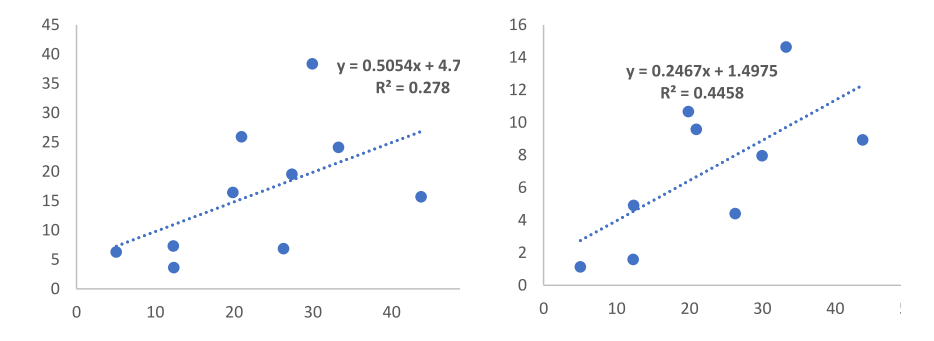
From a trade policy perspective, it is widely argued that governments should not impose trade restrictions on the imports of food during times of shortage and on exports during times of self-sufficiency (Gillson & Busch, 2015). During times of crisis, however, governments tend to impose barriers on food trade to protect consumers and domestic producers, which leads to distortions in domestic food markets and increases food price volatility and, potentially, food insecurity. This is why a strand of the literature argues that agricultural trade liberalization is crucial to enhancing food security and therefore rejects restrictive trade policies, such as tariffs, non-tariff barriers (Yahaya et al., 2024), and export restrictions, even during times of crises (Espitia et al., 2020). A large body of research links trade liberalization to increased food availability and utilization due to the rise of per capita agricultural production and per capita supplies of nutrients and shows that liberalizing trade in staple food improves food access and affordability (Tanaka and Hosoe, 2011). However, another strand of empirical research provides evidence of the adverse effects of trade liberalization on food security due to the low competitiveness of smallholders in low-income countries, coupled with challenges from low infrastructure quality and limited access to technology and finance (Luo & Tanaka, 2021). Figure 1 depicts a positive association between tariffs and the prevalence of moderate and/or severe food insecurity. Indeed, tariffs are harmful to food security as they raise the price of imported food, making it less affordable. The consequences of restrictive trade policies on national welfare extend beyond typical price and quantity effects.
Figure 1: Tariffs and Food Insecurity
|
Tariffs and prevalence of moderate and severe food insecurity |
Tariffs and prevalence of severe food insecurity |
Source: Aboushady and Zaki (2023).
Note: This graph includes available data for MENA countries.
Using data from the Combined COVID-19 MENA Monitor Household Survey constructed by the Economic Research Forum for five countries (Egypt, Jordan, Sudan, Morocco, and Tunisia), we explore the status of food insecurity during the pandemic, as an example of crisis times. We combine the data with data on tariffs on food products to estimate the impact of trade policy restrictions on the different dimensions of food insecurity (affordability, availability, and utilization), with a special focus on vulnerable categories including females, blue-collar workers, and informal workers. The findings suggest that restrictive trade policies worsen food security through the channel of market shortage. The outcome is worse for the most vulnerable, especially low skilled labour and informal employees by reducing their demand for food and compromising its utilization. From a policy perspective, these findings suggest that protectionism does not effectively protect domestic consumers during shocks. In fact, it appears to worsen food security outcomes for the most vulnerable of the population, who are the very individuals these policies were intended to protect.
References:
Aboushady, N. and Zaki, C. (2023). Trade Policy and Food Security in Turbulent Times. Edited by S. C. and G. C., in The impact of the Russia-Ukraine war in the Mediterranean region: the socio-economic consequences, Mediterranean Economies 2023, Bologna, Italy.
Espitia, A., Rocha, N., & Ruta, M. (2020). Covid-19 and Food Protectionism: The Impact of the Pandemic and Export Restrictions on World Food Markets, COVID-19 (Coronavirus). Policy Research working paper no. WPS 9253, Washington, D.C.: World Bank Group. http://documents.worldbank.org/curated/en/417171589912076742
FAO, IFAD, UNICEF, WFP and WHO. 2025. The State of Food Security and Nutrition in the World 2025 – Addressing high food price inflation for food security and nutrition. Rome. https://doi.org/10.4060/cd6008en
FAO. (2023). Food Policy Monitoring in the Near East and North Africa Region. 2nd Quarter 2023 Bulletin. Cairo. https://openknowledge.fao.org/server/api/core/bitstreams/6b9efd6c-ddc1-422c-aab7-b402b921e2d9/content
Gillson, I. & Busch, C. (2015). Trade Policy Responses to High and Volatile Food Prices, in I. Gillson and A. Fouad. Trade Policy and Food Security. Improving Access to Food in Developing Countries in the Wake of High World Prices (135-152), International Bank for Reconstruction and Development, The World Bank, Washington D.C.
Luo, P. and Tanaka, T. (2021). Food Import Dependency and National Food Security: A Price Transmission Analysis for the Wheat Sector, Foods, 10(8), 111. DOI:10.3390/foods10081715
Mimoune, N. & El Shehaby, H. (2023). Breaking the Cycle: How Can the MENA Region Tackle Food Insecurity? Issue Brief, Middle East Council On Global Affairs. https://mecouncil.org/publication/breaking-the-cycle-how-can-the-mena-region-tackle-food-insecurity/
Odjo, S. Traore, F., and Zaki, C. (2024) “African Agriculture Trade Monitor 2024”, International Food Policy Research Institute (IFPRI) and Akademiya 2063.
Tanaka, T. and Hosoe, N. (2011). Does agricultural trade liberalization increase risks of supply-side uncertainty?: Effects of productivity shocks and export restrictions on welfare and food supply in Japan, Food Policy, 36(3), 368-377. https://doi.org/10.1016/j.foodpol.2011.01.002
Yahaya, U., Bernard O., Shaheed, Z.S, Ayodeji, S. & Alfa, Y. (2024). Impact of Tariff and Non-Tariff Barriers on Food Security in ECOWAS Region. https://mpra.ub.uni-muenchen.de/123114/1/MPRA_paper_123114.pdf
[1] Chair Professor of Economics, Laboratoire d’Économie d’Orléans, University of Orléans.