
Geopolitical, Trade, and Fertilisers.
Implications for Agricultural Production and Food Security
The 12th OEET Workshop will be held on December 4–5, 2026, in Turin, in person (online participation can be organized under specific circumstances). The Workshop will address issues related to trade, with a focus on fertilisers and their implications for agricultural production and food security in developing and emerging countries, with an emphasis on the MENA region.
Fertiliser imports are not only an essential input for domestic agricultural production but also play a key role in global food systems, as they are heavily demanded by countries that serve as major hubs for cereal exports to highly populated and arid regions. Recent geopolitical developments, namely the US–Israeli conflict with the Islamic Republic of Iran and Lebanon, have added a source of vulnerability by disrupting shipping through the Strait of Hormuz and restricting access to both agricultural inputs and natural gas, a key input for fertiliser production. Together with the ongoing war in Ukraine, the trade war, and the weakening of multilateralism, these developments have disrupted supply chains, accelerated nearshoring and friendshoring, and increased the risk that local supply-side constraints spread across international markets, threatening agricultural production and food security well beyond the countries initially affected.
Theoretical and empirical contributions are welcome on issues related to (but not limited to):
- The analysis of agrifood trade and disruptions due to the changing geopolitical framework.
- The analysis of the role of fertilisers, especially in relation to food security.
- The implications of disruptions in fertiliser value chains for food trade.
- Policy responses to disruptions in global fertiliser and agricultural commodity markets.
- Fertiliser and energy.
- The impact of geopolitical developments on fertilisers’ prices and consequences.
We invite submissions of complete papers or advanced drafts (long abstract in English of up to 300 words) by October 20, 2026 to:
Logistic information about the meeting will be posted in due time on the websites of OEET and Collegio Carlo Alberto (CCA): The Workshop is financed by the PRIMA research project “STAPLES - STable food Access and Prices and Lower Exposure to Shocks”, of which OEET-CCA is partner.
Download Call for Papers 12th Workshop OEET
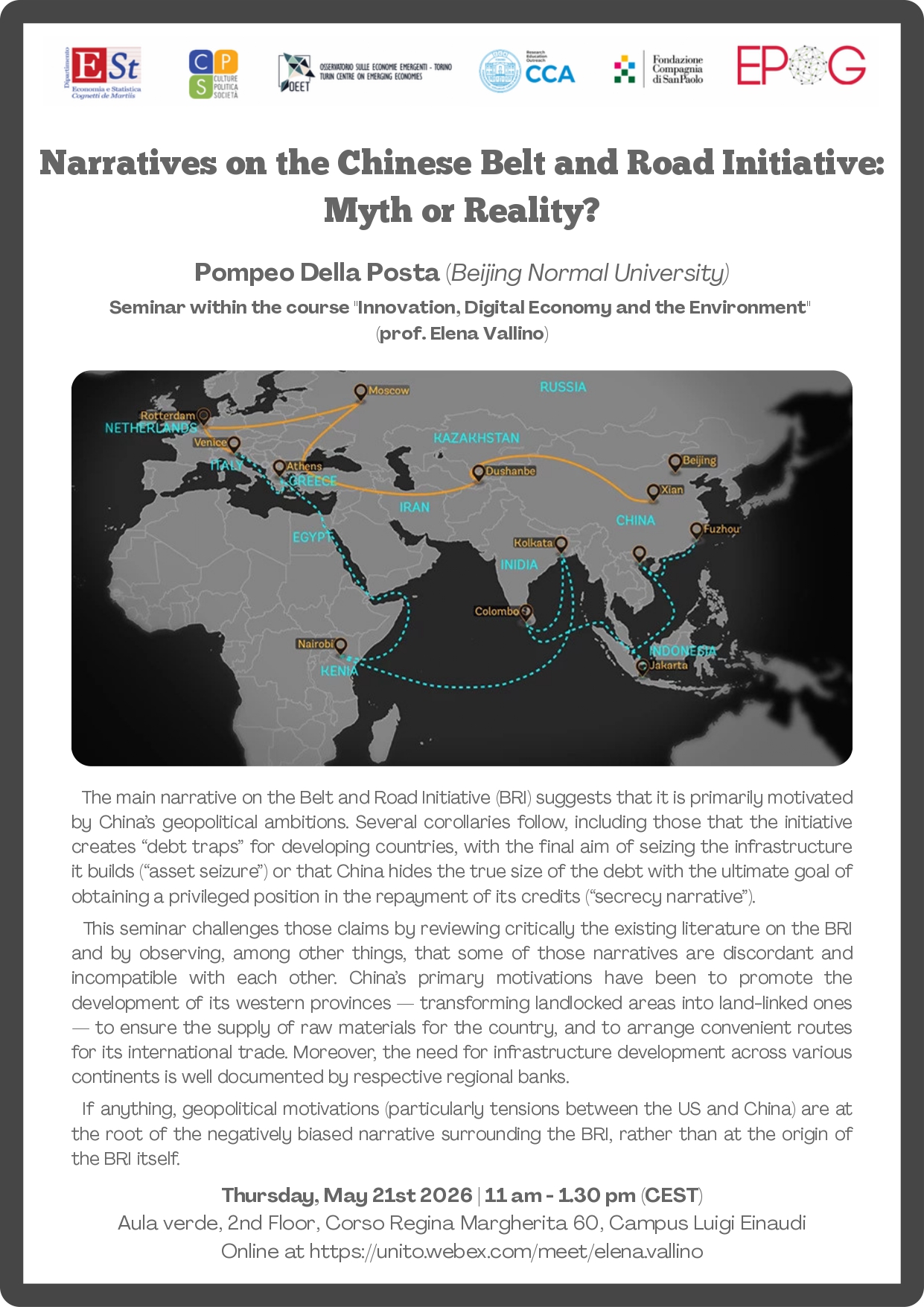
We are glad to announce the OEET Webinar "Narratives on the Chinese Belt and Road Initiative: Myth or Reality?", which will be held by Pompeo Della Posta (Beijing Normal University) on Thursday, May 21st 2026 | 11 am - 1.30 pm (CEST) Aula verde, 2nd Floor, Corso Regina Margherita 60, Campus Luigi Einaudi, Turin.
The seminar takes place within the course "Innovation, Digital Economy and the Environment" (prof. Elena Vallino) and it will be web-streamed via Webex at https://unito.webex.com/meet/elena.vallino
Below you can find an outline of the intervention:
The main narrative on the Belt and Road Initiative (BRI) suggests that it is primarily motivated by China’s geopolitical ambitions. Several corollaries follow, including those that the initiative creates “debt traps” for developing countries, with the final aim of seizing the infrastructure it builds (“asset seizure”) or that China hides the true size of the debt with the ultimate goal of obtaining a privileged position in the repayment of its credits (“secrecy narrative”).
This seminar challenges those claims by reviewing critically the existing literature on the BRI and by observing, among other things, that some of those narratives are discordant and incompatible with each other. China’s primary motivations have been to promote the development of its western provinces — transforming landlocked areas into land-linked ones — to ensure the supply of raw materials for the country, and to arrange convenient routes for its international trade. Moreover, the need for infrastructure development across various continents is well documented by respective regional banks.
If anything, geopolitical motivations (particularly tensions between the US and China) are at the root of the negatively biased narrative surrounding the BRI, rather than at the origin of the BRI itself.
XXIV AISSEC Scientific Conference
Economic Development in the Era of Geopolitical Fragmentation
Marche Polytechnic University, Ancona, Italy
8-9 June 2026
After decades of deepening global integration, the world economy is now shifting toward growing geopolitical fragmentation. This fragmentation is inherently multifaceted, manifesting in disruptions to political alignments, trade, finance, scientific cooperation, and mobility, among other domains. Amid these shifts, Artificial Intelligence has emerged as a critical frontier for both economic development and strategic competition.
This conference invites scholars and practitioners to explore the intersection of these structural transformations and the role of transformative technologies in shaping an increasingly multipolar world, while maintaining a focus on the core challenges of economic development.
We inform you that the submission deadline has been extended to April 24, as announced on the Conference webpage.
The Conference will feature two keynote lectures, by Mariapia Mendola (University of Milano Bicocca) and Klaus Prettner (Vienna University of Economics and Business), on highly topical issues related, respectively, to Anti-Immigration Attitudes and Artificial Intelligence.
Please also note that an Award for the best paper presented by a Young Scholar under the age of 40 will be granted, in memory of Francesco Pastore. For further details, please refer to the website.
Should you have any further questions regarding the Conference, please write to
March 11 Session: Giovanni Balcet on the Expansion of the Chinese Automotive Industry
The next session of the BRICS seminar will take place on Wednesday, March 11, 2026, at 6:00 p.m. at the Maison de la Recherche of INALCO (2 rue de Lille), Salle Borel, and online:
https://zoom.us/j/2458251486?omn=96956547906
The speaker will be: Giovanni Balcet (University of Turin, Osservatorio Economie Emergenti Torino)
Topic: The Multinational Expansion of Chinese Automobile Manufacturers: the Case of Geely Before and After the Acquisition of Volvo Cars
Abstract:
The automotive sector in China has followed a path of accelerated growth. In its initial phase, this growth was driven by the domestic market, which became the largest in the world in 2009, surpassing that of the United States. During this period, strictly regulated international joint ventures played a decisive role in acquiring and assimilating technologies and in structuring the industry.
On this basis, the sector began a process of international expansion, first through exports and later through production abroad and the integration of international production networks. Foreign direct investments (FDIs) aimed at acquiring firms with technological, organizational, and managerial resources—as well as established brands (asset-seeking FDIs)—played a primary role in this process. These operated alongside FDIs aimed at penetrating external markets, beginning with developing and emerging countries.
The rapid growth of Geely, which became the leading private Chinese producer, is a good example of this trajectory. Through foreign acquisitions and the assimilation of industrial technologies and organizational capabilities, this new player has become a global actor. Technological trajectories and international trajectories have thus been integrated into an original growth model.
During the seminar, the stages of these trajectories will be presented, with a focus on the acquisition of Volvo Cars in 2010 and its consequences in terms of technological convergence, industrial dynamics, and intercultural relations within the company. The role of electric vehicles, as well as new platforms and production strategies, will also be highlighted.
About the speaker:
Giovanni Balcet was Professor of International Economics and Multinational Enterprises at the University of Turin. He is Vice-President of OEET – Osservatorio Economie Emergenti Torino, Collegio Carlo Alberto.
More information: https://brics.hypotheses.org/calendrier
French version
Séance du 11 mars : Giovanni Balcet sur l’expansion de l’industrie automobile chinoise
La prochaine séance du séminaire BRICS se tiendra mercredi 11 mars 2026 à 18h à la Maison de la recherche de l’Inalco (2, rue de Lille), Salle Borel (et à distance : https://zoom.us/j/2458251486?omn=96956547906).
Elle recevra: Giovanni Balcet (Université de Turin, Osservatorio Economie Emergenti Torino)
Sur le thème : L’expansion multinationale des constructeurs automobile chinois: le cas de Geely avant et après l’acquisition de Volvo Cars
Résumé:
Le secteur automobile en Chine a suivi une trajectoire de croissance accélérée, tirée dans une première période par le marché intérieur, devenu le plus important au niveau mondial en 2009, dépassant celui des USA. Dans cette période, les sociétés mixtes internationales (joint ventures), strictement réglementées, ont joué un rôle déterminant dans l’acquisition et l’assimilation des technologies et la structuration de cette industrie.
Sur cette base, le secteur a entamé un processus d’expansion internationale d’abord à travers les exportations et ensuite à travers la production à l’étranger et l’intégration des réseaux de production à l’international. Les IDE orientés à l’acquisition d’entreprises possédant des ressources technologiques, organisationnelles et managériales ainsi que des marques affirmées (asset seeking FDIs) ont joué un rôle primaire dans ce processus, parallèlement aux IDE orientés à pénétrer les marchés extérieurs, à partir des pays en développement et émergents.
La croissance rapide de Geely, devenu le premier producteur privé chinois, est un bon exemple de cette trajectoire, où l’acquisition à l’étranger et l’assimilation de technologies industrielles et de capacités organisationnelles a permis à ce nouvel acteur de devenir un protagoniste global. Trajectoires technologiques et trajectoires internationales se sont ainsi intégrées dans un modèle de croissance original.
Au cours du séminaire seront présentées les étapes de ces trajectoires, avec une focalisation sur l’acquisition de Volvo Cars en 2010 et sur ses conséquences en termes de convergence technologique, dynamique industrielle et relations interculturelles à l’intérieur de l’entreprise. Le rôle des véhicules électriques et des nouvelles plateformes et stratégies de production sera aussi mis en lumière.
L’intervenant: Giovanni Balcet a été professeur d’Économie Internationale et Entreprises Multinationales à l’université de Turin. Il est vice-président de OEET – Osservatorio Economie Emergenti Torino, Collegio Carlo Alberto.
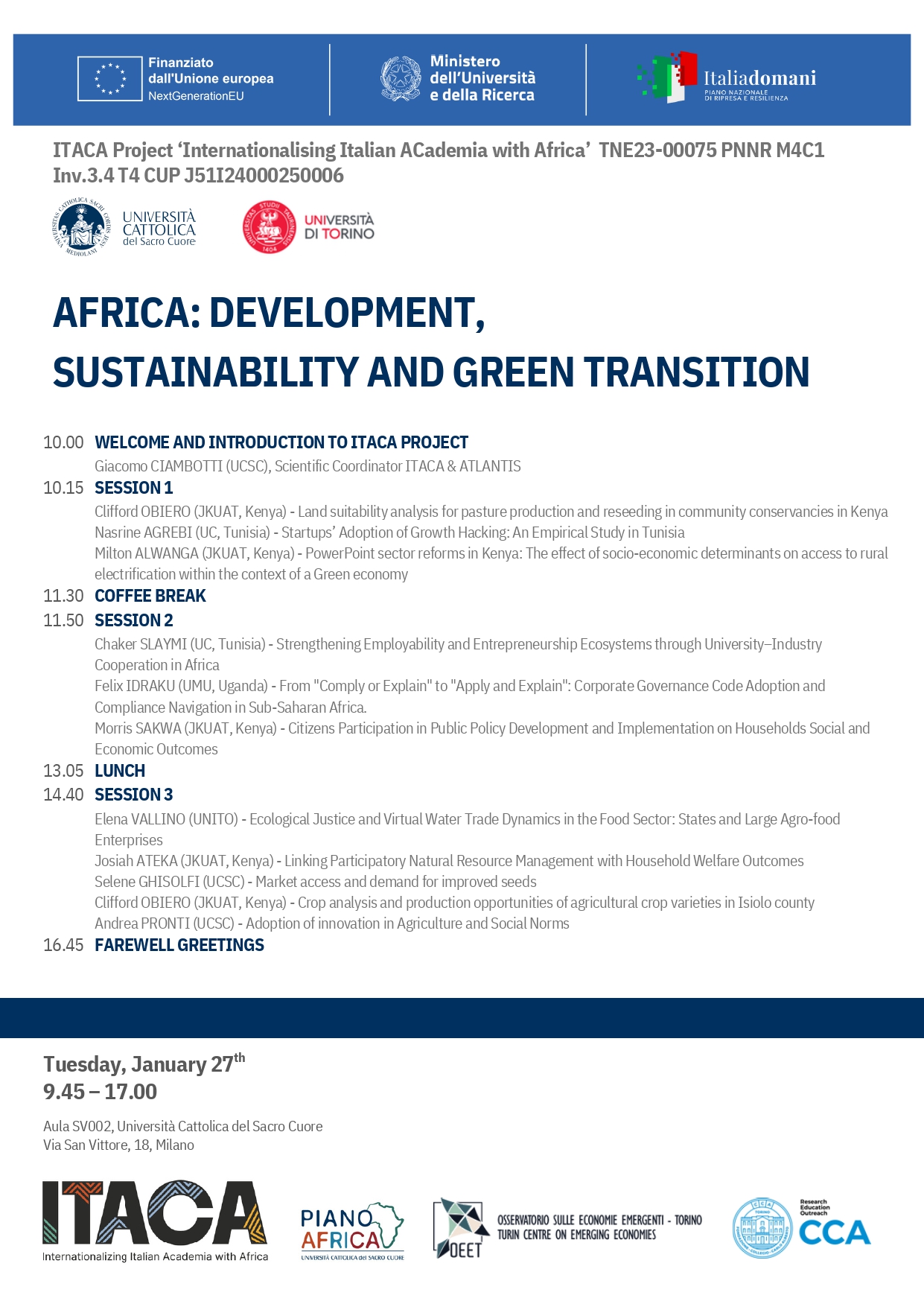
Tuesday, January 27th 9.45 – 17.00
Aula SV002, Università Cattolica del Sacro Cuore; Via San Vittore, 18, Milano
10.00: WELCOME AND INTRODUCTION TO ITACA PROJECT
Giacomo CIAMBOTTI (UCSC), Scientific Coordinator ITACA & ATLANTIS
10.15: SESSION 1
Clifford OBIERO (JKUAT, Kenya) - Land suitability analysis for pasture production and reseeding in community conservancies in Kenya Nasrine AGREBI (UC, Tunisia) - Startups’ Adoption of Growth Hacking: An Empirical Study in Tunisia
Milton ALWANGA (JKUAT, Kenya) - PowerPoint sector reforms in Kenya: The effect of socio-economic determinants on access to rural electrification within the context of a Green economy
11.30: COFFEE BREAK
11.50: SESSION 2
Chaker SLAYMI (UC, Tunisia) - Strengthening Employability and Entrepreneurship Ecosystems through University–Industry Cooperation in Africa
Felix IDRAKU (UMU, Uganda) - From "Comply or Explain" to "Apply and Explain": Corporate Governance Code Adoption and Compliance Navigation in Sub-Saharan Africa.
Morris SAKWA (JKUAT, Kenya) - Citizens Participation in Public Policy Development and Implementation on Households Social and Economic Outcomes
13.05: LUNCH
14.40: SESSION 3
Elena VALLINO (UNITO) - Ecological Justice and Virtual Water Trade Dynamics in the Food Sector: States and Large Agro-food Enterprises
Josiah ATEKA (JKUAT, Kenya) - Linking Participatory Natural Resource Management with Household Welfare Outcomes Selene GHISOLFI (UCSC) - Market access and demand for improved seeds
Clifford OBIERO (JKUAT, Kenya) - Crop analysis and production opportunities of agricultural crop varieties in Isiolo county
Andrea PRONTI (UCSC) - Adoption of innovation in Agriculture and Social Norms
16.45 FAREWELL GREETINGS




Our activities
-
Call for Papers 12th Workshop OEET
Geopolitical, Trade, and Fertilisers.Implications for Agricultural Production and Food Security...